Making Thinking Visible: How Read-Write-Reason™ Unlocks Reading, Writing, and Rigor
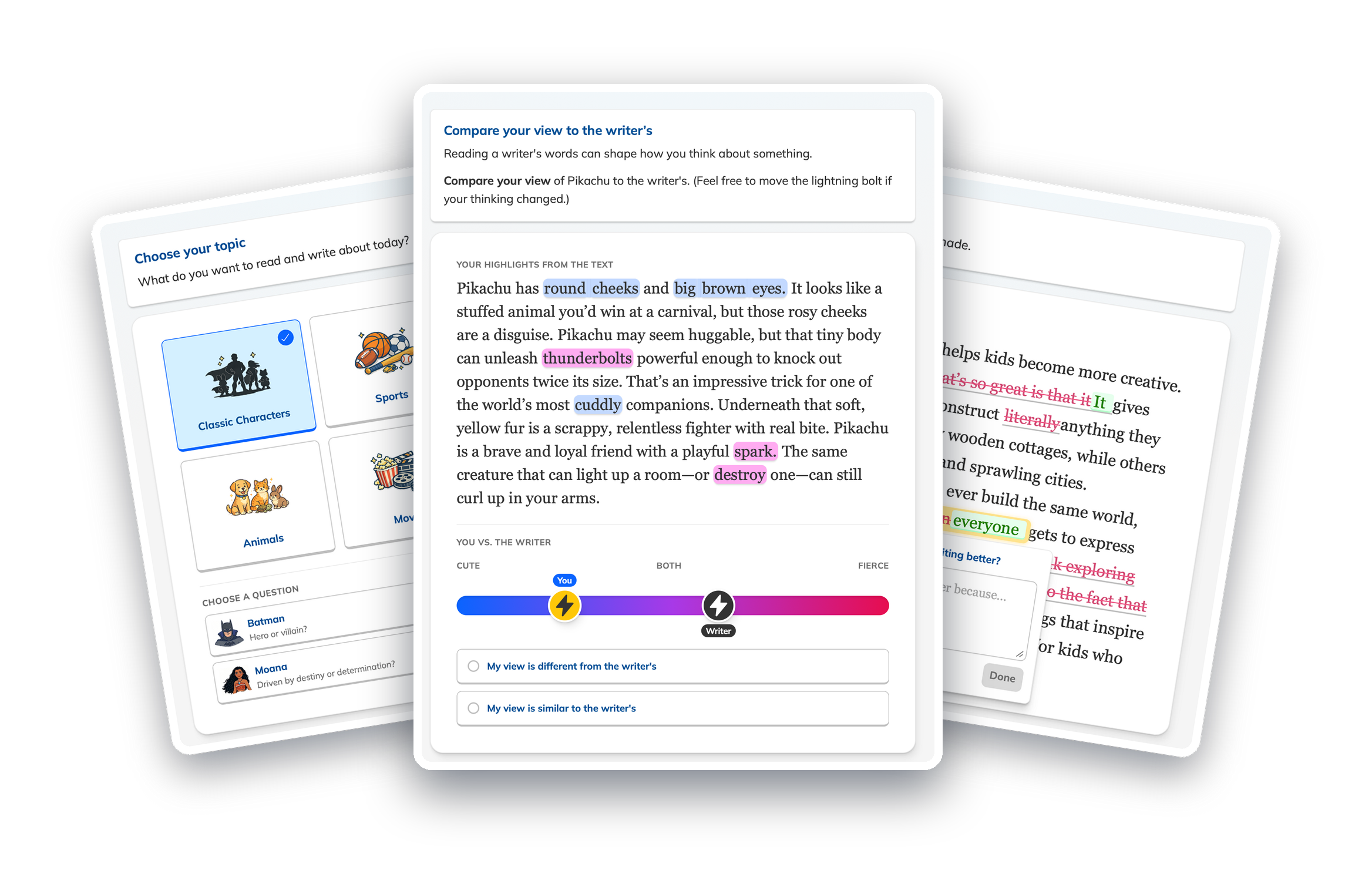
Great writing starts with thinking. Long before a student puts a single word on the page, a lot of cognitive work has already happened and most of it is invisible. As educators, we rarely see the full breadth of choices students are making as they read texts, interpret them, and then decide what to say. Often, students don’t see it either.
That invisibility matters now more than ever as students have access to tools that outsource their reading, thinking, and writing and these same skills show up in standards and high stakes assessments. To give students real insight into their writing choices, NoRedInk created Read-Write-Reason™, a research-backed bridge designed to make critical thinking visible.
Design Instruction to Reveal Thinking
Moving students to engage in deep thinking and learning happens when instruction is designed with the end in mind. Read-Write-Reason™ draws on the Backward Design framework (Wiggins & McTighe, 2005). Our team started by identifying what students need to understand, know, and be able to do, then built engaging ways for students to demonstrate that thinking.
Each activity targets a literacy micro-skill at the intersection of reading and writing. That’s where deeper thinking lives, in metacognitive processes, reflection, and concept mapping (Fisher et al., 2016). Rather than relying on traditional assessment feedback with binary right-or-wrong answers, Read-Write-Reason™ tracks evidence of the thinking process itself, giving teachers real insight into how students arrived at their beliefs, not just what they concluded.
Guide Students Toward Deeper Rigor
Read-Write-Reason™ is tackling some of the hardest higher order thinking skills or depth of knowledge (Bloom et al., 1956; Webb, 2002) to make certain that students have opportunities to think strategically and create authentic writing. If we want to move students to deeper thinking, inquiry, and understanding versus compliance (Kohn, 1999), they need engagement from the beginning and interaction that prompts them to explain their assertions. Through providing high interest content with probing interactions, Read-Write-Reason™ is designed to build student ownership by capturing the three dimensions of rigorous work (Antonetti & Garver, 2015).
Move Students From Compliance to Ownership
Read-Write-Reason™ is designed to put student choice at the center. From topics to claims to word choice, students are asked to make decisions at every step of the process, digging deeper into what interests them most and forming their unique point of view along the way. Students analyze writing, react to prompted questions, and justify their opinions as well as language choices. The multiple points of feedback students receive are non-binary. Activities shift students away from “playing school” (low-level recall/compliance) into active strategic thinking (Webb, 2002, Depth of Knowledge Level 3) where they must evaluate arguments, manipulate tone, and justify their reasoning.
Students thrive when they experience autonomy, connection, and a sense that they can grow (Ryan & Deci, 2000). Pair that with a writing environment built on research-based teaching practices (MacArthur et al., 2025) and real-world personalization (Zhao, 2018), and students are far more likely to harness agency in their work. The goal isn’t task completion, it’s helping students to see themselves as learners able to drive their own success and learning (Ryan & Deci, 2000). NoRedInk recognizes that productive struggle is critical for growth and so we built in scaffolds and feedback to nudge students as they persist through completion.
Extend Benefits Beyond the Classroom
Helping students own their thinking process, and unleashing the writer within, builds more resilient learners and, over time, stronger outcomes on the assessments districts care about most. For years, the cognitive work behind student writing has stayed largely hidden from the educators trying to develop it. With Read-Write-Reason™, that’s no longer the case.
Curious how Read-Write-Reason™ could work in your classroom or district? Explore this page and talk to a member of our team today.
References
Antonetti, J. V., & Garver, J. R. (2015). 17,000 classroom visits can’t be wrong: Strategies that engage students, promote active learning, and boost achievement. ASCD.
Bloom, B. S., Engelhart, M. D., Furst, E. J., Hill, W. H., & Krathwohl, D. R. (1956). Taxonomy of educational objectives: The classification of educational goals. Handbook I: Cognitive domain. Longmans, Green and Co.
Fisher, D., Frey, N., & Hattie, J. (2016). Visible learning for literacy, grades K-12: Implementing the practices that work best to accelerate student learning. Corwin Press.
Kohn, A. (1999). The schools our children deserve: Moving beyond traditional classrooms and “tougher standards.” Houghton Mifflin.
MacArthur, C. A., Graham, S., & Fitzgerald, J. (2025). Handbook of writing research. The Guilford Press.
Ryan, R. M., & Deci, E. L. (2000). Self-determination theory and the facilitation of intrinsic motivation, social development, and well-being. American Psychologist, 55(1), 68–78. https://doi.org/10.1037/0003-066X.55.1.68
Webb, N. L. (2002). Depth-of-knowledge levels for four content areas. Wisconsin Center for Education Research, University of Wisconsin–Madison.
Wiggins, G. P., & McTighe, J. (2005). Understanding by design (2nd ed.). ASCD.
Zhao, Y. (2018). Reach for greatness: Personalizable education for all children. Corwin Press.